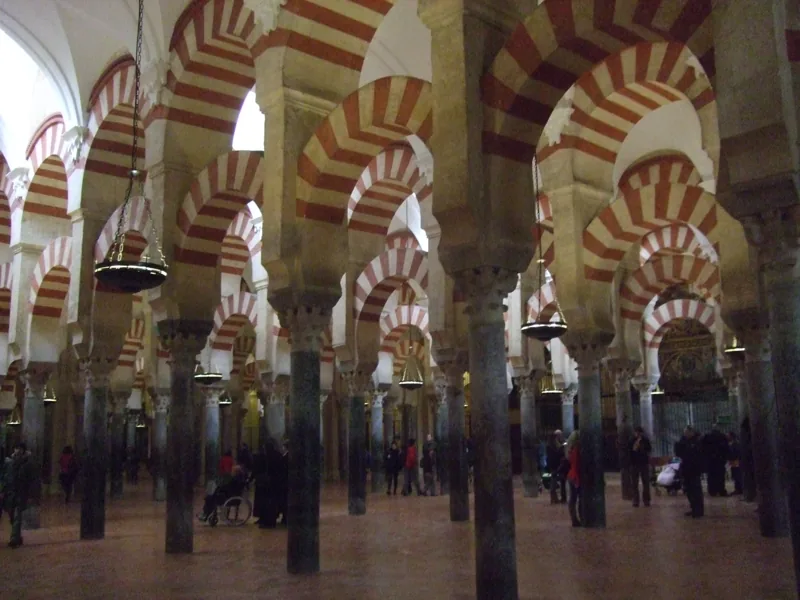
The Mezquita-Catedral de Córdoba is the only major Christian cathedral in the world built inside a functioning Moorish congregational mosque. Construction began in 785 CE under Abd al-Rahman I — first emir of the Umayyad dynasty in Al-Andalus — on the site of a Visigothic basilica. Three later caliphs extended the prayer hall southward and westward across two centuries, reaching its present 23,400 square metres and 856 columns by the late 10th century under al-Hakam II and al-Mansur.
After the Christian Reconquista took Córdoba in 1236, Ferdinand III consecrated the building as a cathedral without demolishing it. For three centuries successive bishops added small chapels around the perimeter while the prayer hall remained intact. Then in 1523, under Charles V, the cathedral chapter inserted a full Renaissance nave, transept and choir into the centre of the mosque — cutting upward through the horseshoe arches to lift a Christian church into the heart of the Islamic hall. Charles V, on visiting the finished work, is famously said to have remarked that the builders had 'destroyed something unique to build something commonplace'.
The result is one of the most architecturally extraordinary buildings in Europe: a Renaissance cathedral surrounded on every side by a forest of double-tiered Moorish arches in alternating jasper, marble and granite. UNESCO inscribed the Mezquita in 1984. It draws approximately 2 million visitors a year and remains an active Catholic cathedral — daily Mass at 09:30, additional services on weekends, with respectful silence expected during all liturgy.